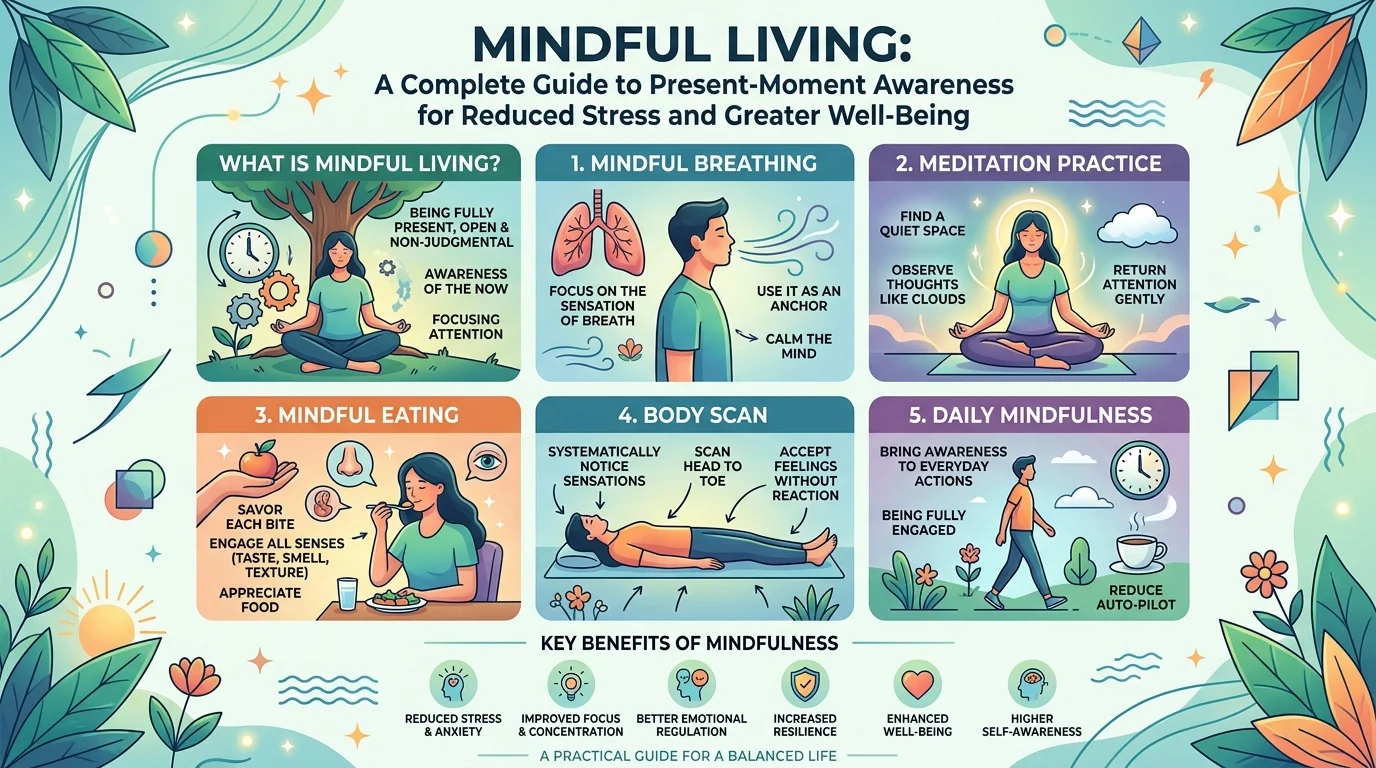
Mindful living has emerged as one of the most transformative approaches to well-being in the modern era, offering a practical antidote to the chronic stress, constant distraction, and automatic pilot that characterize contemporary life. Rooted in ancient contemplative traditions yet validated by extensive scientific research, mindful living involves bringing deliberate, non-judgmental attention to the present moment across all domains of daily existence. This comprehensive guide explores the principles, practices, and proven benefits of mindful living, providing actionable strategies for integrating mindfulness into every aspect of your routine.
Understanding Mindful Living: Beyond Meditation
Mindful living extends far beyond formal meditation practice. While sitting meditation remains a foundational training method, true mindful living infuses awareness into every activity—eating, walking, working, communicating, and even cleaning. The core distinction between ordinary living and mindful living lies in the quality of attention brought to each moment.
When living on autopilot, individuals operate from habit and reactivity, often missing the richness of present experience while ruminating about the past or worrying about the future. Mindful living interrupts this automaticity by training attention to rest on present-moment sensations, thoughts, and emotions without getting caught in judgment or elaboration. This shift from doing mode to being mode transforms mundane activities into opportunities for presence and peace.
The benefits of mindful living extend across multiple dimensions of health. Research demonstrates that regular mindfulness practice reduces stress hormone levels, lowers blood pressure, improves immune function, decreases chronic pain symptoms, and enhances sleep quality. Psychologically, mindfulness reduces symptoms of anxiety and depression, increases emotional regulation, improves focus and cognitive flexibility, and enhances overall life satisfaction. Interpersonally, mindfulness fosters better communication, deeper empathy, and more satisfying relationships.
Core Principles of Mindful Living
Present-Moment Awareness
The foundation of mindful living is the cultivation of present-moment awareness. This involves intentionally directing attention to what is happening right now—the sensations in your body, the sounds in your environment, the thoughts passing through your mind—rather than being lost in回忆 or anticipation. Present-moment awareness does not mean never planning for the future or learning from the past; rather, it means returning to the present as your home base rather than getting trapped in mental time travel.
Non-Judgmental Observation
Mindful living involves observing experiences without immediately labeling them as good or bad, right or wrong, pleasant or unpleasant. This non-judgmental stance does not mean abandoning values or discernment. Instead, it means noticing your automatic judgments as mental events rather than mistaking them for reality. When you observe a thought like “I am doing this wrong,” mindful living allows you to notice that judgment and return to the task rather than getting caught in self-criticism.
Acceptance and Letting Be
Acceptance in mindful living does not mean resignation or passivity. Rather, it means acknowledging reality as it is in this moment without futile resistance. When you accept that you feel tired, anxious, or frustrated, you stop wasting energy fighting against these experiences. This creates space to respond wisely rather than react automatically. Acceptance allows you to work with reality rather than against it.
Beginner’s Mind
Approaching each moment with beginner’s mind means seeing familiar experiences with fresh eyes, as if experiencing them for the first time. This principle counteracts the tendency to operate from assumption and habit, missing the unique qualities of each present moment. Beginner’s mind transforms routine activities—brushing teeth, commuting to work, drinking morning coffee—into opportunities for discovery and wonder.
Practical Applications of Mindful Living
Mindful Morning Routine
The first moments of waking set the tone for the entire day. Rather than reaching immediately for your phone, begin with three conscious breaths before getting out of bed. Notice the sensations of your body resting on the mattress, the temperature of the air, the quality of light in the room. As you brush your teeth, feel the bristles against your gums, taste the toothpaste, notice the movements of your hand. While showering, feel the temperature and pressure of water against your skin, smell the soap, listen to the sound of water. These simple anchors transform automatic morning activities into mindful practices.
Mindful Eating
Mindful eating involves bringing full attention to the experience of food—from the first sight of a meal to the final swallow. Before eating, take a moment to appreciate the appearance and aroma of your food. As you take the first bite, notice the texture, temperature, and flavor. Chew slowly, putting down your utensil between bites to fully experience each mouthful. Pay attention to hunger and fullness cues, eating until satisfied rather than stuffed. This practice not only enhances enjoyment but also improves digestion and prevents overeating.
Mindful Work and Productivity
The workplace often presents the greatest challenge to mindful living, with constant demands, interruptions, and pressure to multitask. Research consistently demonstrates that multitasking reduces productivity and increases errors. Mindful working involves single-tasking—giving full attention to one activity at a time. Before beginning a task, take three conscious breaths to transition your attention. When your mind wanders to other responsibilities, gently return to the task at hand. Use task transitions as mindfulness bells, taking a mindful moment before switching activities.
Regular mini-breaks throughout the workday prevent burnout and maintain focus. Set a timer to ring every hour, and when it sounds, take one minute to notice your breath, stretch your body, or look out a window. These brief pauses reset attention and reduce stress accumulation.
Mindful Communication
Mindful communication transforms relationships by bringing presence and intention to every interaction. Before speaking, pause to notice your intention. Are you speaking from reactivity, habit, or genuine communication? Listen with full attention when others speak, resisting the urge to formulate your response while they are still talking. Notice when your mind has wandered during conversation and gently return attention to the speaker’s words and nonverbal cues.
When difficult emotions arise in conversation, use the STOP technique: Stop what you are doing, Take a breath, Observe your experience (noticing thoughts, emotions, and body sensations), and Proceed with awareness rather than reactivity. This brief pause creates space between trigger and response, enabling wiser choices.
Mindful Movement and Exercise
Physical activity offers rich opportunities for mindfulness practice. Whether walking, running, swimming, or strength training, bring attention to body sensations—the feeling of feet contacting ground, the rhythm of breath, the engagement of muscles. Notice when the mind wanders into planning or回忆, and gently return to physical sensations. This approach transforms exercise from a chore to be completed into a moving meditation.
Walking meditation, a formal mindfulness practice, involves walking very slowly while maintaining detailed awareness of each component of the step—lifting, moving, placing the foot. This practice can be adapted to any walking speed, bringing mindfulness to commuting, errands, or daily walks.
Mindful Evening and Sleep Preparation
The evening hours provide opportunity to mindfully transition from the activity of day to the rest of night. Create a digital sunset, turning off screens at least one hour before bed to allow natural melatonin production. Engage in a mindful body scan before sleep, systematically moving attention through each body part from toes to crown, noticing sensations without trying to change them. This practice relaxes the nervous system and interrupts the racing thoughts that interfere with sleep.
Scientific Evidence Supporting Mindful Living
Decades of research have established the efficacy of mindfulness-based practices across multiple domains. The Mindfulness-Based Stress Reduction program, developed by Jon Kabat-Zinn at the University of Massachusetts Medical Center in 1979, has been studied in hundreds of clinical trials. Research demonstrates that MBSR significantly reduces symptoms of anxiety, depression, and chronic pain while improving quality of life.
Neuroimaging studies reveal that mindfulness practice physically changes the brain through neuroplasticity. Long-term meditators show increased gray matter density in regions associated with attention, emotional regulation, and self-awareness, including the prefrontal cortex and insula. The amygdala, responsible for threat detection and stress responses, shows reduced activation and structural changes with regular practice.
Workplace studies demonstrate that mindfulness training reduces burnout, improves job satisfaction, and enhances cognitive performance including working memory and task focus. Healthcare professionals who practice mindfulness show reduced emotional exhaustion and greater compassion satisfaction.
Common Obstacles and Practical Solutions
Restlessness and Impatience
Many beginners find mindfulness practice uncomfortable, experiencing restlessness, boredom, or impatience. These experiences are not signs of failure but rather opportunities for practice. When restlessness arises, bring curiosity to the sensation. Where in your body do you feel restlessness? What does it feel like physically? This investigation often transforms restlessness from an obstacle into simply another experience arising and passing away.
Sleepiness
Falling asleep during mindfulness practice is common, particularly for exhausted individuals. Counter drowsiness by practicing with eyes open, changing to a standing or walking posture, or practicing at times of day when naturally more alert. However, if sleepiness consistently indicates insufficient rest, consider whether your body is asking for sleep rather than meditation.
Self-Judgment
The most persistent obstacle for many practitioners is self-judgment—criticizing yourself for having a wandering mind, feeling like you are “doing it wrong,” or comparing your practice to imagined standards. Remember that noticing your mind has wandered is the moment of mindfulness, not a mistake. Each time you return attention to your chosen anchor, you strengthen the neural pathways of attention, regardless of how many times your mind wandered before.
Building a Sustainable Mindful Living Practice
Start Small and Specific
The most common reason mindfulness practices fail is overambition. Begin with just two to five minutes of formal practice daily, at the same time and place whenever possible. Anchor your practice to an existing habit, such as meditating immediately after brushing your teeth in the morning. As consistency establishes, gradually extend practice duration.
Integrate Rather Than Add
Rather than viewing mindfulness as one more task on an already full schedule, integrate practice into existing activities. Choose three routine activities each day—washing dishes, waiting in line, walking between meetings—and commit to doing them mindfully. These informal practices require no additional time but build mindfulness capacity.
Use Technology Wisely
Mindfulness apps including Headspace, Calm, and Insight Timer provide guided meditations, timers, and progress tracking. These tools can support practice development, particularly for beginners. However, be mindful of using technology mindfully—noticing whether app use enhances presence or becomes another distraction.
Find Community Support
Practicing with others provides accountability, encouragement, and shared learning. Local meditation groups, online communities, and mindfulness courses offer structured support. Many communities offer free or donation-based groups, making mindfulness accessible regardless of financial circumstances.
Mindful Living Practices Summary Table
| Daily Domain | Mindful Practice | Time Required | Key Benefit |
|---|---|---|---|
| Morning | Three breaths before phone, sensory awareness during hygiene | 2-5 minutes | Sets intentional tone for day |
| Eating | Chew slowly, utensil between bites, notice flavors | 10-15 minutes per meal | Improved digestion, portion control, enjoyment |
| Work | Single-tasking, hourly mini-breaks, task transition pauses | 1 minute per hour | Reduced errors, less burnout, better focus |
| Communication | STOP technique before responding, full listening | Variable | Fewer conflicts, deeper understanding |
| Movement | Attention to body sensations during exercise | Throughout exercise | Transformed relationship to physical activity |
| Evening | Digital sunset, body scan before sleep | 10-20 minutes | Improved sleep quality, reduced racing thoughts |
| Walking | Awareness of feet, breath, and environment | Throughout walking | Turns necessary movement into meditation |
Frequently Asked Questions
Q: How is mindful living different from meditation?
A: Meditation is a formal practice where you set aside dedicated time to train attention, typically focusing on breath, body sensations, or other anchors. Mindful living extends this trained attention into all daily activities, bringing the same quality of awareness to eating, working, communicating, and resting. Meditation strengthens the muscle of attention; mindful living uses that muscle throughout the day.
Q: How long does it take to see benefits from mindful living?
A: Some benefits appear immediately—even a single mindfulness session reduces stress and improves mood in the moment. Structural brain changes and lasting reductions in anxiety and depression typically require consistent practice over eight to twelve weeks. However, even inconsistent practice provides immediate value through increased present-moment awareness and reduced automatic reactivity.
Q: Can mindful living help with anxiety and depression?
A: Yes. Mindfulness-Based Cognitive Therapy (MBCT) is specifically designed to prevent relapse of major depression and is as effective as maintenance antidepressant medication. For anxiety, mindfulness reduces rumination, worry, and catastrophic thinking while increasing tolerance for uncomfortable emotions. However, mindfulness is a complement to rather than replacement for professional mental health treatment when needed.
Q: Do I need to sit cross-legged on a cushion to practice mindfulness?
A: No. Mindfulness can be practiced in any posture—sitting in a chair, standing, lying down, or walking. The essential要素 is bringing intentional, non-judgmental attention to present-moment experience, not any particular body position. For formal practice, choose a posture that is both alert and comfortable, allowing you to remain awake without strain.
Q: What should I do when my mind wanders constantly during practice?
A: Notice that your mind has wandered without judgment. Recognize the content of the wandering briefly, then gently return attention to your chosen anchor—breath, body sensations, or sounds. Each return strengthens attention, regardless of how many times wandering occurs. Consistent wandering is not failure but rather the raw material of practice.
Q: How do I practice mindfulness when I am very busy or stressed?
A: Brief practices are particularly valuable during busy periods. Take three conscious breaths before answering the phone. Notice the sensation of your feet on the floor during meetings. Practice one mindful bite at the beginning of rushed meals. Even one second of genuine presence interrupts the stress cycle and creates space for wiser responding. Do not wait until life calms down to practice—busy times are when mindfulness is most needed.
Q: Is mindful living compatible with religious or spiritual beliefs?
A: Yes. Mindfulness, as taught in contemporary secular contexts, is a universal human capacity for attention and awareness, not a religious practice. Individuals from all religious traditions and none practice mindfulness without conflict with their beliefs. Mindfulness programs in hospitals, schools, and corporations intentionally present the practice in entirely secular terms while respecting diverse backgrounds.
Q: How can I teach mindful living to my children?
A: Children learn mindfulness best through modeling and simple, brief practices. Practice mindful breathing together for one minute before meals. Take mindful walking breaks during outdoor time. Use a mindfulness bell or app sound as a signal to pause and notice the breath. Keep practices short, playful, and pressure-free. The most powerful teaching is your own example of responding rather than reacting to life’s challenges.
Leave a Reply